Field Note: What Nobody Tells You About Road Access Before You Buy Backcountry Land
Posted by Starlene Bennin and Ashlyn Windsor | Red Hawk Realty | sempervets.com
If you have ever looked at a parcel out in the backcountry and thought the biggest question was the well or the septic, we understand. Those are real concerns. But in our experience working with buyers in rural San Diego County, road access quietly causes more deal problems — and more post-closing headaches — than almost anything else on the list. So let us break it down the way we do with our own clients.
There are actually two separate road access questions, and you need good answers to both of them.
The first is legal access. The second is physical access. They are not the same thing, and a property can have one without the other.
Legal Access: The Paper Trail That Protects You
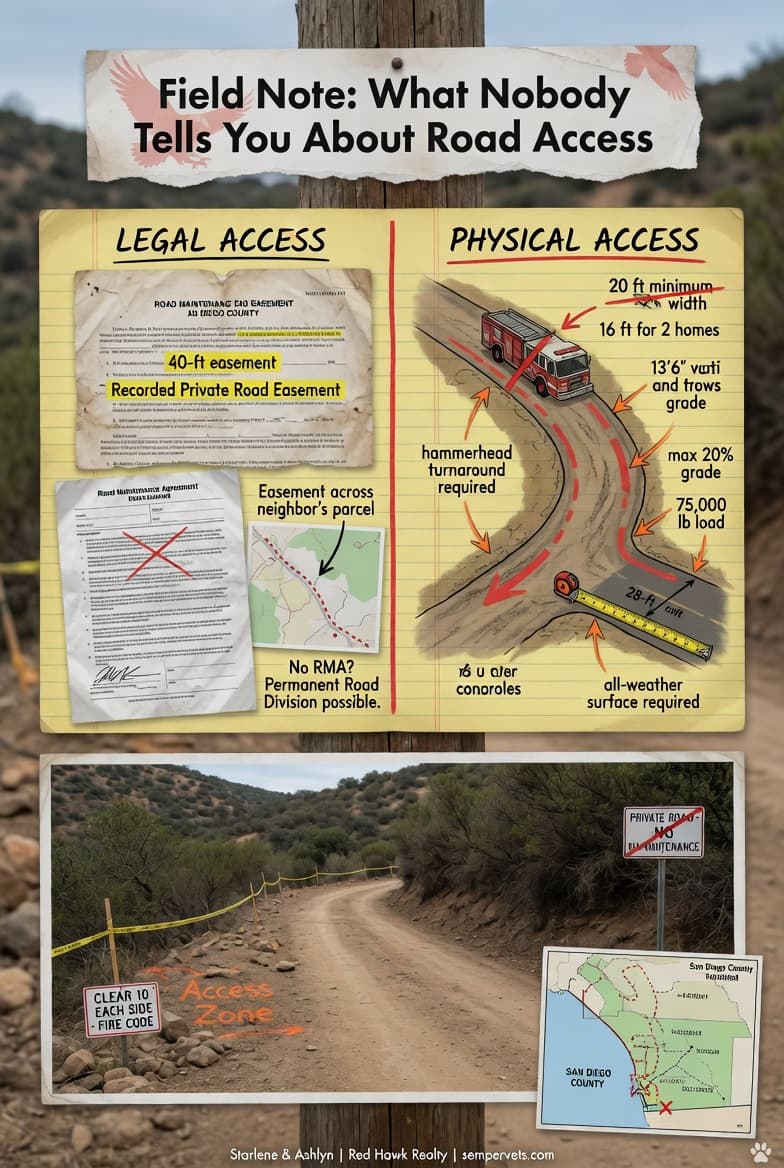
Every lot in San Diego County must either front on a dedicated public road or be served by a recorded private road easement. This is not optional — it is a requirement for title insurance and for any future development on the land.
Out here in the backcountry, a direct connection to a public highway is rare. Most rural parcels are reached via private roads, which means an easement needs to exist in the chain of title giving you the legal right to cross someone else's land to get to yours. Those easements typically need to be at least 40 feet wide for subdivided parcels, though some narrower exceptions exist.
The easement alone is not the whole picture either. Once you are on a private road, who pays to maintain it? That question should be answered by a Road Maintenance Agreement, or RMA. A formal RMA spells out how costs and repairs are split among the property owners who use that road. If there is no RMA in place, the County does offer a Permanent Road Division program through the Department of Public Works that can help neighbors form a district and fund maintenance through property taxes. It is a path worth knowing about, but it takes time and coordination — not something you want to figure out after closing.
Physical Access: What the Fire Code Actually Requires
San Diego County enforces strict fire access standards under its Consolidated Fire Code, and these are non-negotiable when you go to build or develop. The standards exist for good reason. In a wildfire, minutes matter, and fire apparatus has to be able to reach your structure.
Here is what those standards look like in practice.
The standard improved width for a fire access road is 20 feet, unobstructed. A driveway serving no more than two single-family dwellings may qualify for a 16-foot width. Vertical clearance must be at least 13 feet 6 inches to accommodate large engines. The road surface must be all-weather — asphalt or concrete is generally required on steeper grades — and the road bed must be able to support 75,000 pounds.
Grade matters too. The maximum grade is generally 20 percent. Horizontal inside turning radii must be at least 28 feet. And if a dead-end road runs longer than 150 feet, an approved turnaround — a hammerhead or cul-de-sac configuration — is required.
When you are walking a raw parcel, look at the existing road or driveway and ask yourself honestly whether it meets those numbers. If it does not, bringing it into compliance is a real cost that belongs in your offer calculus.
One More Thing: Vegetation and the Access Zone
Even if the road itself checks every box, there is an ongoing maintenance obligation that goes with backcountry ownership. Property owners are required to keep at least 10 feet of cleared vegetation on each side of their driveway, creating what is called an Access Zone. This is not just a code requirement — it is the kind of thing that determines whether a fire crew can safely reach your home when conditions are at their worst.
Who Maintains the Road You Drive In On?
San Diego County maintains roughly 2,000 miles of roads. If your access route includes any private segment, the County will not repair or improve that stretch unless it is formally brought up to public standards and accepted into the County system. Any work you do within a County right-of-way — connecting a new driveway to a paved road, for example — requires a Right-of-Way Permit from the Department of Public Works.
Why This Matters Before You Make an Offer
Starlene and Ashlyn have seen buyers fall in love with a piece of land only to discover mid-escrow that the access easement is missing, too narrow, or simply not recorded. We have also seen buyers inherit shared road situations with no written agreement and no clear path to resolving it. These are solvable problems in the right circumstances — but they are far easier to solve before you are under contract than after.
If you are exploring backcountry property in San Diego County and want to talk through what you are looking at, reach out to us at sempervets.com. This is our backyard, and we are here to help you navigate it.